
01
Chapter 1 • Why access matters | Pages 1–14
The opening introduces Echo AI for internists and clinical–engineering collaboration. Pages 4–8 frame service demand and specialist constraints; pages 9–12 discuss EF in cardiac assessment; pages 13–14 then propose a workflow using ultrasound images and a smartphone.
The central idea is for clinical personnel to record video from existing equipment and send it to cloud AI for assessment support. Early slides use disease and mortality figures to motivate the work; they are not outcomes demonstrated by EasyEF, nor should figures from different years be treated as current statistics without verification.
Source: CNF 2026, pp. 1–14
02
Chapter 2 • Initial evidence and the care pathway | Pages 15–22
Page 15 points to the 2024 study. Pages 16–18 contrast the existing service journey with a proposed pathway informed by earlier screening. Referral prioritization and multidisciplinary work explain how an assessment result might connect to care delivery.
Pages 19–21 discuss collaboration and heart-failure clinic organization; page 22 presents product positioning. These pathway illustrations and comparisons are not a head-to-head trial and must not be used to guarantee waiting times, prices, or treatment outcomes.
Source: CNF 2026, pp. 15–22; 2024 paper, pp. 123–132
03
Chapter 3 • Demonstrations and reports | Pages 23–41
This portion contains demonstrations and application screens. Pages 26–27 introduce usage steps, and pages 33–34 identify reports for printing and transfer. The emphasis is connecting a clip to an assessment that a clinical team can communicate, rather than displaying a model percentage alone.
Pages 35–38 include guideline material and poor LV / HFrEF examples. This guide does not reproduce medication instructions for treatment or personal details from demonstration screens. The cumulative count on page 24 lacks sufficient unit and evaluation detail to serve as a confirmed study sample or number of patients benefiting.
Source: CNF 2026, pp. 23–41
04
Chapter 4 • Readiness and architecture | Pages 42–48
Page 42 discusses TRL; page 43 connects the internet, server, and API; page 44 presents five- and three-category classification; and page 45 describes smartphone-video challenges such as framing, reflections, and motion. These pages show that the engineering problem begins with input quality.
The table on page 44 differs from some results in the 2024 paper, so the paper is used when reporting that study. Pages 46–47 propose handheld and existing-machine integration; page 48 discusses preparation of intellectual-property rights, which is separate from medical-device authorization.
Source: CNF 2026, pp. 42–48; 2024 paper, pp. 128–131
05
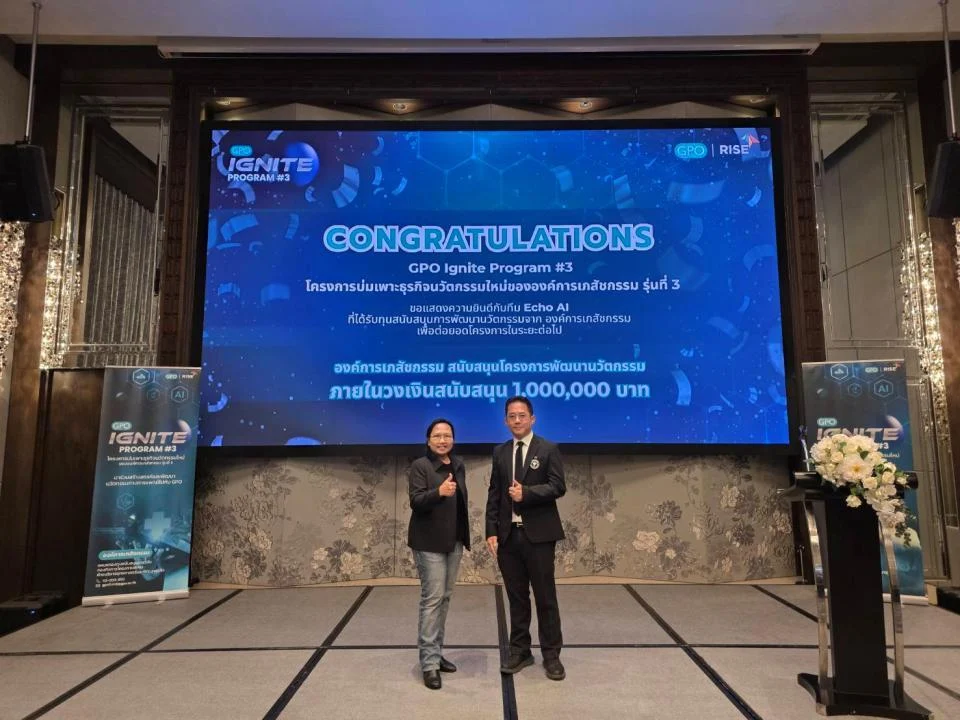
Chapter 5 • Access and GPO Ignite recognition | Pages 49–52
Pages 49–51 return to access and outpatient / inpatient contexts. Page 52 then records EasyEF winning the GPO Ignite program 2025 award. This supports the website’s award reference, with the award year distinguished from the presentation year.
The award recognizes innovation; it does not certify accuracy in every category or establish SaMD status. The recognition story should be read alongside the next chapter’s study findings, including both the overall result and its limitations.
Source: CNF 2026, pp. 49–52
06
Chapter 6 • The Rayong findings | Pages 53–59
After the Real world test heading and study team, page 55 identifies 218 Rayong Hospital participants from December 2025–January 2026: 76 pre-chemotherapy and 142 general LV function assessments, with registered-nurse operation and cardiologist confirmation.
Pages 57 and 59 report 93.6% overall accuracy, 100% for poor LV, 96.9% for good LV, and 27.3% for fair LV, plus 98.7% for pre-chemotherapy and 90.8% for general assessment. Page 58 interprets a referral scenario. Publication and peer-review status remain unverified, and this is not controlled-trial evidence of referral reduction.
Source: CNF 2026, pp. 53–59; Rayong abstract, pp. 1–3
07
Chapter 7 • Invitation to collaborate | Pages 60–61
The final substantive slide invites partners to contribute parasternal long-axis clips for research on valve conditions, pericardial conditions, pulmonary hypertension, and abnormal masses. This is a data and research agenda, not a list of conditions the system has been validated to detect.
Collaboration should begin by agreeing the question, data scope, governance, and reference evaluation before transferring real data. The current public contact channels for this website are LINE mae.t.ace and telephone 0615656599.
Source: CNF 2026, pp. 60–61
SOURCE NOTES
Sources for this page
- เอกสารนำเสนอ / Presentation: EasyEF Lunch Symposium, CNF 17th, 26 March 2026 — หน้า / pp. 1–61
- บทความวิจัยปี 2567 / 2024 original article — J Prapokklao Hosp Clin Med Educat Center 41(2):123–132 ↗
- บทคัดย่อการศึกษาระยอง ไทย–อังกฤษ หน้า 1–3 / Rayong study abstract, Thai and English, pp. 1–3; publication and peer-review status not verified / ยังไม่ยืนยันสถานะตีพิมพ์และการทบทวนโดยผู้ทรงคุณวุฒิ
Presentations reflect information at the time they were prepared. Explore context and evidence status in the resource library.
Explore the source library →